Trading Through Conflict : How to Earn During Wartime Volatility
Learn how to turn geopolitical tension into profit by monitoring critical energy corridors like the Strait of Hormuz
CRYPTOPREDICTIONONLINE EARNING
Sheraz
4/22/20264 min read
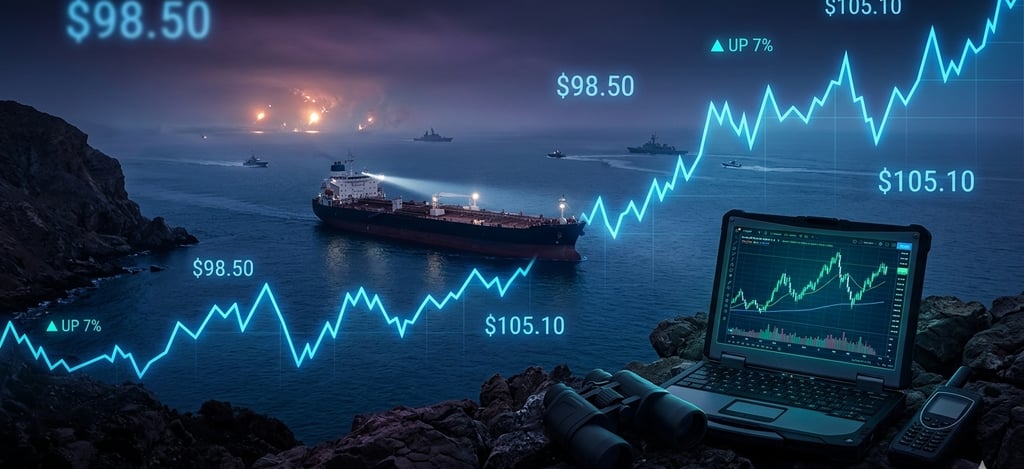
Navigating Global Crisis: How We Turn Geopolitical Chaos into Opportunity
In the world of trading, they tell you to stay away from uncertainty. They tell you that when war breaks out or when a vital waterway like the Strait of Hormuz is under threat, you should sit on the sidelines.
We disagree.
At Ayeraz, we believe that uncertainty is simply information that other people haven't processed yet. During the recent escalation in the Strait of Hormuz, my personal strategy like combining rigorous news tracking with prediction markets and commodity futures allowed me to turn calculated research into substantial returns. I am talking about 10x gains on specific positions, pushing my portfolio up by over $11,000 in a matter of weeks.
This isn't about gambling. It is about identifying where the crowd is wrong and positioning yourself before the market corrects itself.
The Prediction Market Advantage (Polymarket)
Most people look at a headline and panic. We look at a headline and ask: "Is the market currently pricing this in correctly?"
Polymarket is the perfect tool for this. You are not betting on a price chart; you are betting on the outcome of reality.
Oil Price Targets
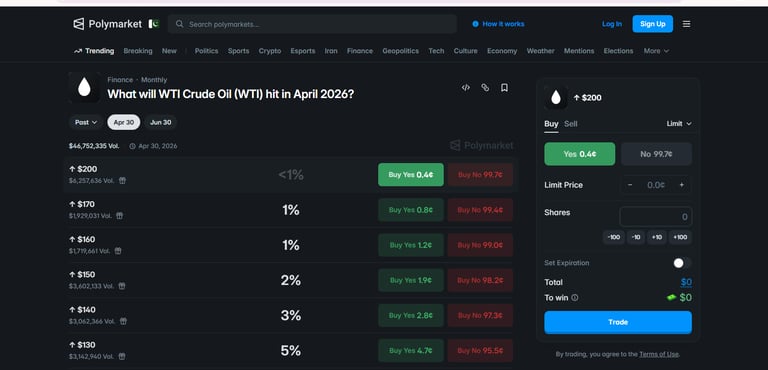
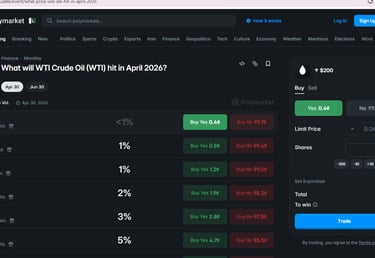
Look at the prediction market for WTI Crude Oil hitting specific price targets in April 2026.
The market is currently pricing a 5% probability on oil hitting $130. That is a "Yes" share price of 5 cents ($0.05). If you believe, based on current reports of tanker seizures and the fragile ceasefire, that a total energy supply shock is coming, you have an edge.
The Math: If you invest $100, you are buying 2,000 shares at $0.05 each. If the price spikes to $130 and you are proven right, your payout is $2,000. That is a 20x return on your capital. You are betting against the market consensus, but you are doing it based on hard evidence.
The Strait of Hormuz Traffic
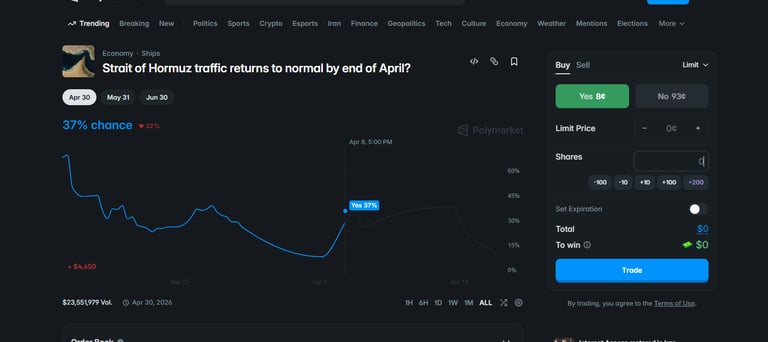
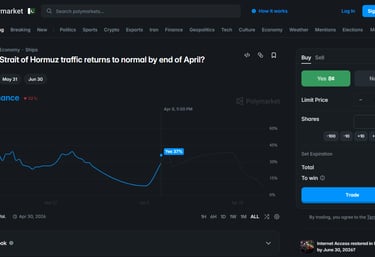
This is a sentiment play. The market is currently betting on whether traffic will return to normal by the end of April.
With a "Yes" price of 37 cents, the market is unsure. It is leaning toward "No."
The Strategy: If you are reading the same news we are , that ships are being seized even during ceasefire talks, that 37% "Yes" price is likely too high. You bet "No."
The Math: If you bet $100 on "No" (the inverse of the 37% "Yes" price), you are securing a position that pays out as the reality of the crisis sets in. If the traffic remains blocked, the "Yes" percentage drops, and your "No" shares become more valuable.
Diplomatic Outcomes
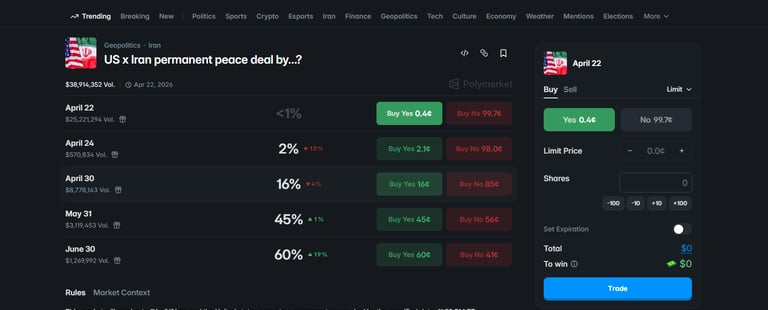
Finally, look at the US and Iran peace deal market.
At a "Yes" price of 60 cents, the market is fairly confident a deal will happen.
The Strategy: This is a "probability" bet. If you believe the talks in Islamabad are failing and that the ceasefire is just a delay, you bet "No."
The Math: Betting $100 here is a safer, high-confidence play. If the deal fails, your $100 pays out significantly, rewarding you for trusting your analysis of the diplomatic stalemate over the market's optimism.
Trading Through crypto (Binance/Bitget)
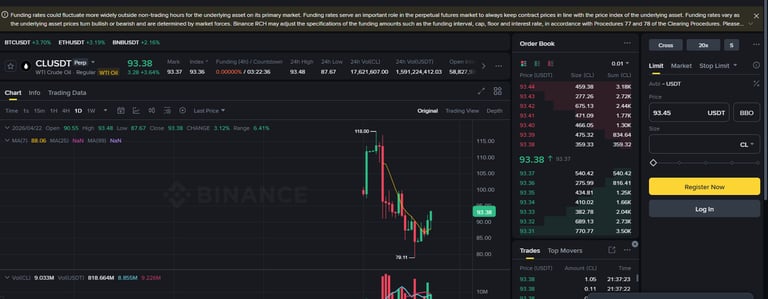
While Polymarket deals with events, trading on Binance using the CLUSDT ticker is where we capture the movement of the oil price itself.
This is where the real daily volatility happens. When you see news of an attack in the Strait, oil prices do not wait for a "market resolution"; they move instantly.
To trade this effectively:
Use the Chart: Look for the technical trend. If the price of oil is climbing, it is because the market is pricing in supply risk.
Size Your Position: Because this is a perpetual contract, you can use leverage. But remember, the $11,000 I earned was not from going "all in" on one trade. It was from using small, consistent positions where my "stop loss" was tight.
The Golden Rule: Never trade without a stop loss. In a war scenario, news can break at 3 AM. If the market moves against you, you need to be out before it wipes your account.
The Research Loop
If you want to replicate these results, you have to stop acting like a trader and start acting like an analyst.
Every morning, we perform this loop:
Monitor: We check the latest reports on the Strait of Hormuz. Are ships being seized? Are talks failing?
Verify: We check Polymarket. Is the crowd ignoring the danger? If yes, we buy the "No" position or "Long" the oil commodity on Binance.
Exit: We never get greedy. We set a profit target, and when the market hits it, we take the money off the table.
Trading in a war zone is not about being right 100% of the time. It is about being right enough, and managing your risk so that when you are wrong, it costs you almost nothing.
Stay sharp, keep researching, and remember that for the informed trader, the world's most dangerous places are often where the best opportunities are hiding.